
NICOLAS LEHMANN, FREE TRAIL RUNNER
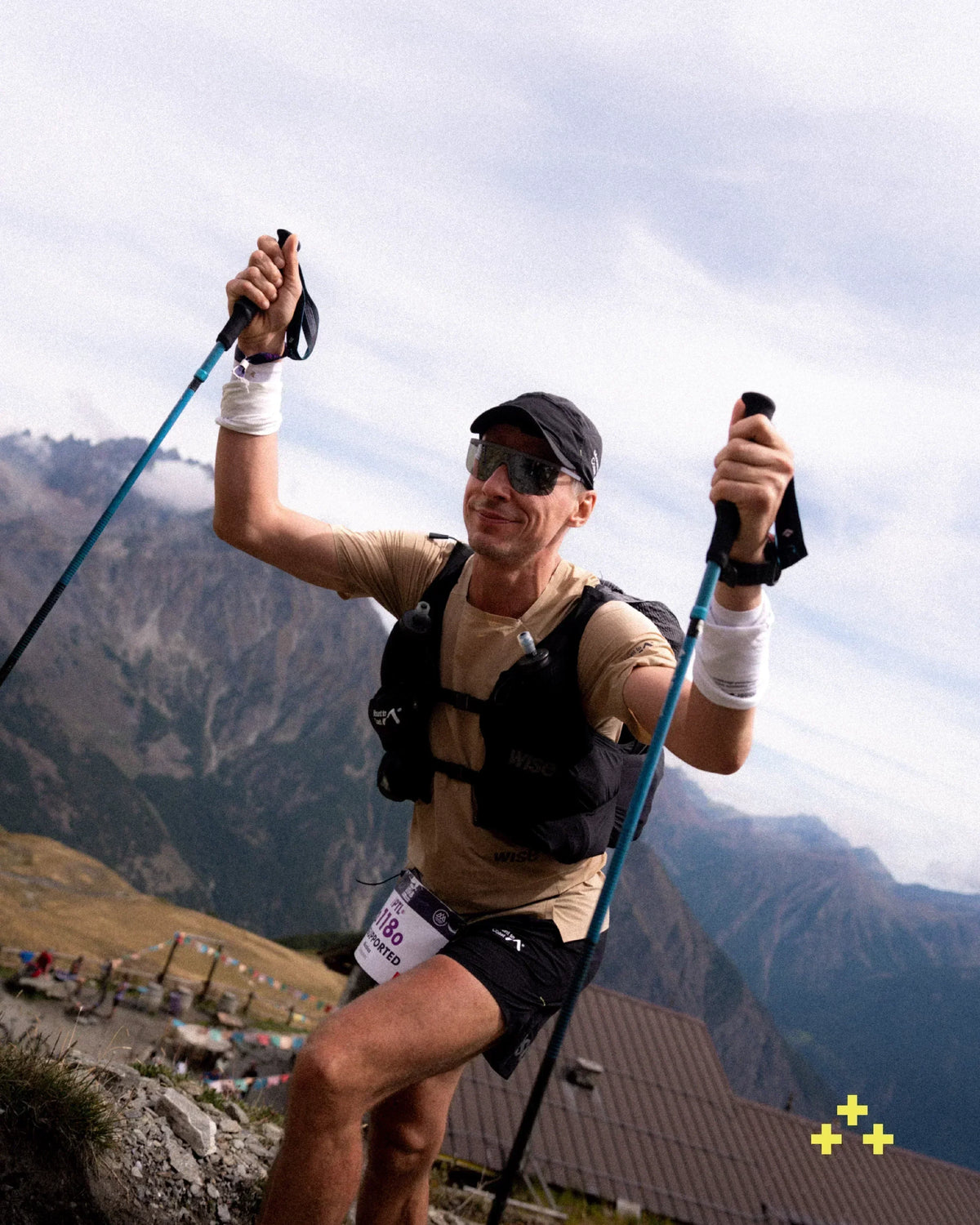
With a permanent smile on his face and the calm of someone who’s just come back from a Sunday stroll, Nicolas Lehmann has actually just finished the Petite Trotte à Léon: 300 kilometres and 25,000 metres of elevation gain, as a team and self-supported, on one of the most demanding courses in ultra-trail running. Nico doesn’t run for sponsors, and he doesn't run for a living. He has no one to answer to, no contract to honour, no result to deliver for anyone else. Sure, he runs a lot. But mostly, he runs for himself. And, quite clearly, he has a lot of fun doing it.

Free Trail Runner, then. Not a new discipline to add to trail running’s already extensive vocabulary, just a way of approaching running: as freely as possible. Beyond times and performance, we sat down for a quick chat with a runner who cares deeply about that freedom. We catch up with him just as he’s about to return to his other reality: the office and his job in IT.
Far from complaining about it, Nico actually seems to enjoy this life of contrasts: “In the morning, I’ll do a quick up-and-down of the Salève. I’m in shorts and a T-shirt and, thirty minutes later, I’m in a suit and tie filling out Excel spreadsheets. Then in the evening, I swap my manager’s suit for my running shoes again. And at that point, I don’t have to answer to anyone!”

SO, DID YOU ENJOY THE PETITE TROTTE À LÉON?
Absolutely. The course was super technical. This year’s route was incredible, really wild. We discovered so many amazing places.
Personally, I ran just a little below my maximum pace throughout the race, so it was pretty enjoyable. I could really make the most of it. And I recovered very quickly afterwards.
I’m definitely not saying it was easy, though! You sleep an hour and a half a night, you’re moving for twenty to twenty-one hours a day — it’s super intense. But at that pace, the landscapes fly by, and you get to see so many new places.
It’s amazing.
With all that fatigue, are there never moments when your mind starts to wander?
No. For me, a race isn’t some kind of inner journey or anything. In fact, since I started doing UTMB races, I’ve never had hallucinations or moments where I start losing it, even when you’re really pushing the limit!
During a race, you’re completely focused. You’re thinking about the route, race strategy, what you need to do next. It takes up all your mental space.
But if I’m just out in the mountains for myself, then it’s different. You can let your mind wander. The relationship with it isn’t the same.
What I love about the PTL is that it’s still really wild compared to other, more conventional races. This year was particularly demanding. There’s no outside assistance allowed along the route, and I love that too. Between the mountain huts, you’re on your own. You go through some incredibly remote places, and now and then you stop at a hut to grab something to eat.

THAT RINGS A BELL
The Cabane des Grands, for example, wasn’t listed among the huts officially welcoming race participants. But as we passed by with Sébastien Raichon, my teammate for the race, they rang the bell and offered us a plate of pasta and a Coke.
Obviously, we stopped.
We started chatting with the super cool hut volunteers, and honestly, we were so comfortable there that it became really hard to leave.
This race has less of that “industry” feel you sometimes get elsewhere, where some aid stations almost feel like McDrives. And that’s something I really loved about it.

SIX HOURS AHEAD, A PISTACHIO FLAN AND THIRTY MINUTES AT THE FINISH.
What’s the story with that pistachio flan just before crossing the finish line? Even L’Équipe wrote about it. Go on, tell us your version!
That was a completely surreal scene.
On the final night of the race, we realised there was no way we were going to catch the leaders. So we didn’t go crazy trying and got a little sleep instead. Then in the morning, as we were getting close to the finish, Séb got a call from race control saying they weren’t ready for us yet and that we needed to slow things down!
So we stopped at the first bakery we came across.
And had an absolute feast. We just kept ordering all kinds of incredible French pastries. Since we were really close to the finish, within a few minutes, loads of people started joining us: friends, journalists — even Christine showed up.
The tea room was complete chaos. It was pretty surreal! The few regular customers in the bakery had absolutely no idea what was going on.
The atmosphere was amazing. We were laughing, completely losing track of time. At that point, we’d almost forgotten we were still racing. Then suddenly, Séb had a brief moment of clarity. I heard him say:
“Shit, where are the guys in third?!”
They weren’t very far behind us anymore.
So we quickly got going again, swallowing our last pistachio flan on the way out. Originally, we had a six-hour lead over third place. By the time we crossed the finish line, we had thirty minutes left.
Haha!

OWING NOTHING TO ANYONE
I like working 100%. It means I’m completely financially independent and takes away any pressure to perform in races. So for me, it’s 100% about enjoyment. Maybe I’d recover better if I didn’t have to get up at 5 a.m. every morning, but having a job also gives me a rhythm and motivation. Before work, when you get out of work, even at lunchtime — there’s only one thing you want to do: go running.
Maybe the reason I have a relationship with running that I enjoy so much is precisely that I don’t have any obligations. Being financially independent means I can choose to collaborate only on projects and with brands that I genuinely connect with, without having to consider anything else. I don’t have results to deliver or expectations to meet.
If I started structuring my entire year around objectives, sponsors, and having people to answer to, I think I’d arrive at the start line with less freshness, and maybe less naivety too. Right now, when I’m standing on the start line, I’m simply happy to be there and excited to run. I really want to hold on to that.
I think that in ultra-trail running, mental availability is what really makes the difference. And sometimes I wonder whether becoming more professional about it (having a personal coach and everything that comes with that) might take away some of that lightness that means so much to me when I’m standing on the start line.
CIGARETTE AFTER CIGARETTE
Let’s finish with the most basic question: when did you actually start running?
I started running when I was 30.
Back then, I smoked cigarette after cigarette; I was pretty sedentary, I drank regularly, and my lifestyle was terrible.
I started running simply because some colleagues suggested it.
You know, your typical corporate thing. And in the end, I caught the bug.
For the past three or four years, I’ve been completely into it. I don’t think about whether I started too late. I don’t care, as long as I’m still enjoying it this much.
And since I’m not exactly getting any younger either, the machinery needs a certain amount of maintenance. For that, I can count on the Keepushing center in Geneva!
Otherwise, I spend quite a bit of time at the osteopath, getting massages, and I need to be fairly disciplined with core work and stretching.
Anyway, as long as I’m having fun, I’ll keep running. And for now, I’m definitely not planning on stopping anytime soon!

To be continued :)
Comments